
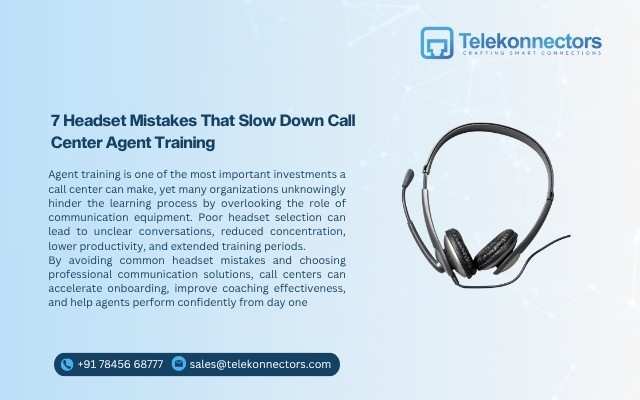
7 Headset Mistakes That Slow Down Call Center Agent Training
Agent training is one of the most important investments a call center can make, yet many organizations unknowingly hinder the learning process by overlooking the role of communication equipment. Poor headset selection can lead to unclear conversations, reduced concentration, lower productivity, and extended training periods. By avoiding common headset mistakes and choosing professional communication solutions, call centers can accelerate onboarding, improve coaching effectiveness, and help agents perform confidently from day one.
Training a new call center agent is far more than teaching scripts and processes. It involves building confidence, improving communication skills, developing listening abilities, and preparing agents to handle real customer interactions effectively.
Every training session, coaching discussion, mock call, and customer interaction depends on one critical tool: the headset.
Many organizations spend considerable resources developing training programs while paying little attention to the equipment agents use during those programs. As a result, new employees often struggle with distractions, poor audio quality, and communication challenges that make learning more difficult than it needs to be.
A quality headset does more than facilitate conversations. It helps trainees absorb information clearly, engage in coaching sessions, and gain confidence during customer interactions.
Telekonnectors has worked with businesses across industries to provide professional communication solutions that support productivity, collaboration, and superior customer service outcomes. One common observation across successful contact centers is that high-performing teams rarely compromise on headset quality.
Let’s explore seven common headset mistakes that can slow down call center agent training and discover how to avoid them.
Mistake 1: Choosing Headsets Based Only on Price
Budget considerations are important for every organization. However, selecting headsets solely because they are inexpensive often creates long-term challenges.
Low-cost devices may initially appear attractive, especially when purchasing equipment for large teams. Unfortunately, cheaper headsets often come with limitations such as:
- Poor audio clarity
- Lower durability
- Uncomfortable designs
- Inferior microphones
- Limited noise reduction capabilities
These issues can directly impact training quality.
When trainees struggle to hear trainers or customers clearly, they require more repetition and clarification. Over time, these communication barriers slow down learning progress and reduce training efficiency.
Instead of focusing only on upfront costs, organizations should evaluate the long-term value that professional communication equipment provides.
Mistake 2: Ignoring Background Noise During Training
Modern contact centers are rarely quiet environments. Multiple conversations, ringing phones, keyboard activity, and team discussions create constant background noise throughout the workday. For new agents who are still developing listening and communication skills, these distractions can be overwhelming.
When trainees cannot clearly hear coaching instructions or customer conversations, they may:
- Miss important details
- Require repeated explanations
- Make avoidable mistakes
- Take longer to gain confidence
This is why many organizations invest in the best noise cancelling headset for call center environments.
Noise cancellation technology helps agents focus on conversations without being distracted by surrounding activity. This creates a more productive learning environment and allows trainees to concentrate fully on customer interactions.
Mistake 3: Overlooking Comfort During Long Training Sessions
Training programs often involve extended periods of headset usage. Agents may spend hours participating in coaching sessions, listening exercises, role-playing activities, and supervised customer interactions.
An uncomfortable headset can quickly become a distraction.
Common issues include:
- Excessive weight
- Tight headbands
- Poor ear cushioning
- Pressure on the ears
- Heat buildup during long sessions
Discomfort causes trainees to lose focus and become fatigued more quickly. Professional-grade solutions are designed with ergonomics in mind, allowing agents to remain comfortable throughout the day. Comfortable employees are generally more engaged, attentive, and productive during training.
Mistake 4: Using Consumer Headsets Instead of Business-Grade Solutions
Many organizations assume that any headset can support training activities. While consumer headsets may work adequately for occasional communication, they are rarely designed for demanding call center environments.
Business communication requires:
- Consistent audio quality
- Reliable microphone performance
- Long-term durability
- Compatibility with communication platforms
- Extended daily usage
A Professional Headset For Call Center operations is specifically engineered to meet these requirements.
Unlike consumer devices, professional communication headsets are designed to support continuous business use while maintaining performance standards throughout the workday.
Telekonnectors regularly recommends enterprise-grade communication solutions because they provide the reliability and performance needed in high-volume customer service environments.
Mistake 5: Failing to Standardize Equipment Across Training Teams
Consistency plays an important role in successful training programs. When trainers use one headset model while trainees use several different models, communication quality can vary significantly.
This inconsistency often creates challenges such as:
- Uneven audio experiences
- Different microphone performance levels
- Variable comfort standards
- Additional technical support requirements
Standardized equipment helps create a more predictable training environment.
It also simplifies troubleshooting, equipment management, and onboarding processes.
Organizations that maintain consistent communication technology often experience smoother training operations and better overall agent performance.
Mistake 6: Choosing Headsets Without Future Growth in Mind
Many businesses purchase equipment based solely on immediate requirements. However, contact centers often grow, expand, or adopt new communication technologies over time.
A headset solution that works today should also support future business needs.
Consider factors such as:
- Unified communication platform compatibility
- Remote work support
- Wireless connectivity options
- Scalability requirements
- Integration with customer service systems
Investing in flexible communication solutions helps organizations avoid costly upgrades and disruptions later.
Forward-thinking businesses view communication technology as a strategic investment rather than a short-term expense.
Mistake 7: Underestimating the Impact of Microphone Quality
Most headset discussions focus on what the agent hears. However, microphone performance is equally important. During training, supervisors need to clearly evaluate:
- Voice tone
- Communication skills
- Pronunciation
- Customer interaction quality
- Call handling techniques
A poor microphone can distort speech and make coaching more difficult.
Customers may also struggle to understand agents if background noise interferes with conversations.
High-quality microphones help ensure that every interaction remains clear and professional.
This supports both effective coaching and improved customer experiences.
How Better Headsets Accelerate Agent Learning
When communication barriers are removed, learning becomes more effective.
Professional headset solutions contribute to training success by helping agents:
- Hear instructions clearly
- Focus on customer conversations
- Participate confidently in coaching sessions
- Reduce distractions
- Improve communication skills faster
- Adapt quickly to real-world scenarios
The result is a smoother onboarding process and faster progression from trainee to productive team member.
Organizations that prioritize communication quality often experience shorter learning curves and stronger performance outcomes.
Why Noise Cancellation Has Become Essential for Modern Call Centers
Customer expectations continue to rise. Callers expect professional interactions regardless of whether agents are working in busy offices, hybrid environments, or remote locations.
Noise cancellation technology helps maintain consistent call quality across different work settings.
This is particularly valuable for:
- Large contact centers
- Open office environments
- Hybrid teams
- Remote customer support agents
- High-volume service operations
Today’s leading organizations increasingly view noise cancellation as a necessity rather than a luxury.
Investing in the best noise cancelling headset for call center teams can significantly improve both training effectiveness and long-term operational performance.
Supporting Supervisors and Trainers
Effective training is not only about helping agents.
Supervisors and trainers also benefit from professional communication equipment.
Clear audio allows trainers to:
- Monitor calls accurately
- Provide precise feedback
- Identify improvement areas quickly
- Conduct coaching sessions efficiently
- Support agents more effectively
When communication quality improves, coaching quality often improves as well.
This creates a positive cycle where agents learn faster and trainers achieve better outcomes.
Selecting the Right Headset for Training Programs
When evaluating communication equipment, organizations should consider:
Audio Quality
Clear sound helps trainees absorb information and communicate effectively.
Noise Reduction
Background distractions should be minimized whenever possible.
Comfort
Headsets must remain comfortable throughout long workdays.
Durability
Training equipment should withstand daily business use.
Compatibility
Devices should integrate seamlessly with existing communication systems.
Scalability
The solution should support future organizational growth.
A Professional Office Headset For Call Center teams should deliver strong performance across all these areas while supporting the organization’s training objectives.
Building Stronger Call Center Teams Through Better Technology
Successful call centers recognize that employee performance is influenced by the tools provided to them. Even the most comprehensive training program can be affected by poor communication equipment.
When organizations invest in professional-grade technology, they create an environment where agents can focus on learning, supervisors can coach effectively, and customers receive better service.
This approach supports:
- Faster onboarding
- Improved productivity
- Better customer satisfaction
- Reduced training costs
- Stronger employee confidence
As customer expectations continue to evolve, communication technology will remain a critical component of contact center success.
Conclusion
Agent training is the foundation of every successful call center operation. While organizations often focus on processes, scripts, and coaching methods, the role of communication equipment should never be underestimated. Poor audio quality, excessive background noise, uncomfortable designs, and unreliable devices can all slow down learning and reduce training effectiveness.
Avoiding these seven common headset mistakes can help organizations create a more productive training environment where agents learn faster, communicate better, and gain confidence more quickly. Investing in professional communication solutions is not simply about improving calls and it’s about supporting employee development and delivering exceptional customer experiences.
Telekonnectors understands the communication challenges faced by modern contact centers and offers advanced headset solutions designed for training, customer service, and daily operations. Whether you’re onboarding new agents or upgrading your communication infrastructure, Telekonnectors can help you find the right headset solution to improve productivity, enhance training outcomes, and support long-term business growth. Contact Telekonnectors today to explore professional headset options tailored for your call center needs.
FAQs
1. Why are headsets important during call center training?
Headsets play a critical role in helping agents hear instructions clearly, communicate effectively, and participate successfully in coaching sessions.
2. How do noise cancelling headsets improve agent training?
Noise cancelling technology reduces workplace distractions, allowing agents to focus better on customer conversations and trainer feedback.
3. What features should training headsets include?
Important features include audio clarity, microphone quality, comfort, durability, noise reduction, and compatibility with communication platforms.
4. Can poor headset quality affect customer service?
Yes. Poor audio quality can lead to misunderstandings, longer call times, and reduced customer satisfaction.
5. Are professional headsets better than consumer headsets for call centers?
Absolutely. Professional headsets are specifically designed for extended business use and provide superior reliability, comfort, and communication quality.
6. How long should a call center headset last?
A high-quality business headset can last several years when properly maintained and used in professional environments.
7. Why do growing call centers need scalable headset solutions?
Scalable communication solutions support future expansion, technology upgrades, and evolving workplace requirements without requiring frequent replacements.